The 17-minute rule

I learned about the 17-minute rule a few years ago when I was reading a book about screenwriting. 

The idea is that the first act of pretty much any movie ends around page 17 of the screenplay, or about 17 minutes into the movie (give or take a minute).

Act I is the setup. We meet the characters, figure out when and where we are, and then something happens that starts the ball rolling. The hero passes a threshold of sorts, and there’s no going back.

Here’s an example:

George Bailey tells his father he couldn’t face being cooped up the rest of his life in a shabby little office at his father’s building and loan 17 minutes into It’s a Wonderful Life.

The rest of the movie is about everything that happens that stops him from leaving Bedford Falls and drives him to consider jumping off that bridge on Christmas Eve.

It isn’t just old movies that follow the 17-minute rule:

  • Luke’s uncle buys the droids 17 minutes into Star Wars. The droids are what leads Luke to Obi-Wan Kenobi and Princess Leia and, ultimiately, the Death Star.
  • Buddy leaves the North Pole to find is real dad 17 minutes into Elf.
  • The shark eats the little boy on the raft 17 minutes into Jaws. It’s the second attack that forces the town to close the beach and go after the shark.
  • The Iowa farmer is thinking about plowing under the baseball field he built in his cornfield until Shoeless Joe appears 17 minutes after the credits in Field of Dreams.

Of course, the 17-minute rule isn’t set in stone.

In the book I was reading, Lew Hunter’s Screenwriting 424, the chairman emeritus of UCLA’s film school calls it the “floating page 17” rule, meaning the scene setting up the rest of the movie should come around page 17. There are plenty of examples of where that scene comes sooner or later — but only a little sooner or later.

How come?

Hunter says, basically, that 17 pages (about 17 minutes of screen time) is about how long it takes to set up the story and pull people in. Sooner, and we don’t know enough about the characters to care about what happens next. Later, we just get bored.

Ever since I read Hunter’s book, I can’t help but notice when Act I ends and Act II begins, and when I check the clock, we’re usually around the 17-minute mark.

The 5 stages of trick-or-treaters

Jack-o-latern
Image: Toby Ord, Wikipedia

Halloween falls on Sunday, which, of course, is church night, so some communities are having trick-or-treat tonight, Saturday, although I wouldn’t be surprised to get trick-or-treaters both nights, and I wouldn’t be surprised if some trick-or-treaters double dip.

When I was a kid in eastern Kentucky, we had 5 distinct stages of trick-or-treaters:

  1. The demons we knew. These were the kids of friends of the family. Mom would make special goodie bags for them — caramel popcorn balls and full-sized candy bars.
  2. The demons we kind of knew. These were random kids in the neighborhood. They got miniature Hershey bars. The kids in our neighborhood generally wore decent costumes (or at least a mask). They always said “Trick or treat!” and usually said, “Thank you!”
  3. The demons we didn’t know. We lived in a subdivision out in the country, so these little monsters were random kids from out in the country. They didn’t live in a neighborhood, so they’d hit several subdivisions and maybe go into town. They generally didn’t wear costumes, as such. They’d wear old clothes and smear lipstick or something on their faces. They looked like psychotic clowns. They usually came in groups, and at least some of them would say, “Trick or treat,” like that. Flat, with no enthusiasm. They might or might not say, “Thank you.”
  4. The demons we suspected were collecting candy for their obese moms waiting in the car. The fourth wave of kids would come near the end of trick-or-treat. If trick-or-treat was supposed to end at 8, they’d come at a quarter of. They usually didn’t wear costumes and rarely spoke. They didn’t have a special Halloween candy bag. They’d carry pillow cases, and when you opened the door, they’d just hold it out, joylessly. This wasn’t fun for them. This was a job.
  5. Teenagers. Some might wear masks, but most didn’t. They giggled like Beavis and Butt-head, like we were stupid, like we didn’t know they were too old to trick-or-treat. After the first group of teenagers, Dad would snuff out the candle in the jack-o-lantern and turn off the porch light — the international signal for saying, “We’re not playing anymore” — but we’d still get four or five more groups of teenagers. It was around this time of night that someone would put an M-80 or a cherry bomb in our jack-o-lantern and blow it up.

Things are different where we live now. The kids all wear costumes. They’re all polite. We get some double-dippers, but not many, although near quitting time, we still get a few teenagers. That’s when we turn out the light and call it a night.

I still bring in the pumpkin, though, just in case.

You gotta love old amusement parks

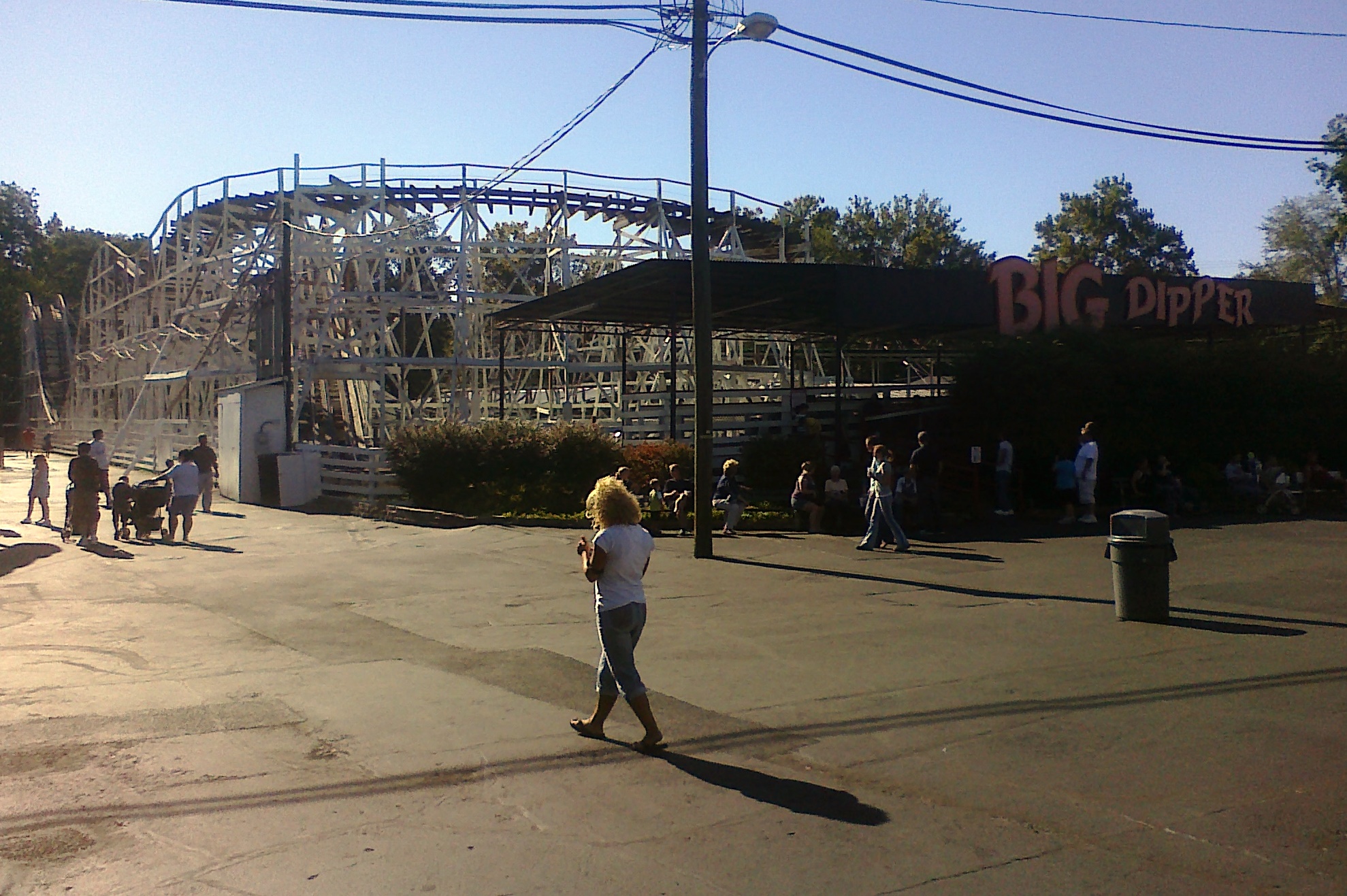
Every summer, when we visit my parents in eastern Kentucky, we take the kids to Camden Park.

Camden Park’s a neat old amusement park in Huntington, West Virginia,  a few miles from the Kentucky line and across the river from Ohio.

It started as a trolley park over 100 years ago, a picnic area along the Camden Interstate Railway. Some of its rides have been around since the Eisenhower administration and look it, too, but that’s part of what makes it great.

Out of habit, my wife calls it a theme park (we used to live in Orlando), but there’s a big difference between a theme park and a place like Camden Park.

For starters, there’s no theme, nothing tying the place together, no attempt at storytelling.

Camden Park’s roller coaster is just a coaster. It isn’t a rocket ship or a fighter jet.

Camden Park’s coaster, the Big Dipper, is made of wood, not steel, and it’s scary enough without a back story — not because it’s especially fast (because it isn’t), but because it opened in 1958 and looks like it could collapse at any moment.

Of course, that’s how it looked when I was a kid, and it’s still standing. It’s a lot sturdier than it looks.

You don’t have to stand in long lines to ride the rides at Camden Park, either.

Lord knows how long you’d have to wait to ride Harry Potter and the Forbidden Journey at Islands of Adventure, but you’ll wait 5, maybe 10 minutes to ride the Tilt-a-Whirl at Camden Park. The line would be even shorter if the operator didn’t give everyone a good, long ride.

Something else I love about old amusement parks is that the rides are simple.

Disney’s Haunted Mansion is this elaborate special effects show, but Camden Park’s Haunted House is a twisty little ride powered by gravity, black lights and what could be props from the Halloween store in the old strip mall.

Everything about Camden Park’s Haunted House is low tech, including the brakes. When the ride’s over and you turn that final corner and come outside, your car, which probably weighs 500, 600 pounds, is stopped by hand.