Family History: Following My Family History from the Appalachian Coalfields Back to Colonial New England

Here’s another column on family history and genealogy that my dad, Clyde Roy, published a while back in The Paintsville Herald.

When I was a kid in Muddy Branch, I didn’t think of myself as Southern, exactly. I don’t think I thought of myself as much of anything, really, but I sure didn’t picture myself as a Yankee.

It turns out, though, that I am Yankee, at least a little bit.

Several years ago, my son, Todd, became the family genealogist. Sometimes, when people do genealogy, they just copy other family trees they find online and call it a day. Todd doesn’t do that. He’s looked on Ancestry.com and FamilySearch.org, but he’s also spent hours and hours in libraries and courthouses and state archives to find the birth and death certificates, marriage licenses and lawsuits, deeds, and wills that, when you put them all together, reveal our family’s history.

I already knew a little about the Pack family line. I knew, for example, that my granddaddy’s granddaddy and granny were Berry and Rebecca Pack. I knew they lived in Lawrence County and died about 60 years before I was born.

I didn’t know anything, though, about Rebecca’s parents, my third great-grandparents.

I didn’t know that Rebecca’s dad was a Revolutionary War soldier named Silas P. Wooten. He enlisted in Virginia and fought in the Battle of Guilford Courthouse down in North Carolina. He was discharged soon after, but instead of going back to Virginia, he stayed in Guilford County. We don’t know why, but I suspect it was because he’d met a girl from Nantucket.

Her name was Phebe Worth. Her parents were Quaker, and it turns out the Quakers kept great records.

We know, for example, that Phebe’s parents left Nantucket and joined a Quaker community in Guilford County in 1772 when Phebe was 12 years old. And we know that Phebe’s great-great-grandfather was a man named Thomas Gardner.

Thomas – my 8th great-grandfather – arrived in Massachusetts in 1624. He was hired to oversee a fishing village on Cape Ann but moved his family to Salem a couple of years later. Thomas’ son, Richard, was one of the first English settlers on Nantucket.

Thomas’s descendants – and, therefore, my blood relatives, and maybe yours, too – include Henry Cabot Lodge Jr., who was Richard Nixon’s running mate in the 1960 presidential race; R.H. Macy, whose department store I’ve been to many times at the Huntington Mall; and J.A. Folger, whose coffee may be the best part of waking up.

I was skeptical about all this at first – it all happened so long ago – but it checks out. There’s a paper trail, and Todd went so far as to join several genealogical societies just so people who know about this stuff could check his work. He’s now a member of Sons of the American Revolution, the Hereditary Order of the First Families of Massachusetts, and the National Society of Sons and Daughters of the Pilgrims.

Of course, knowing about this branch of the family tree has no practical benefits. Macy’s won’t give me a family discount, and Food City makes me pay full price for a can of Folger’s.

Still, I catch myself thinking sometimes about my great-great-great-grandmother Phebe. She was born on Nantucket, a crescent-shaped island 30 miles out in the Atlantic, and died up a hollow in Lawrence County. I can’t help but wonder if she ever missed the ocean or the sea breeze and being able to see to the horizon.

All I know is that, without her, I wouldn’t be here today.

The worst Halloween ever (or, the night a girl and her mom stole my candy)

When I was 5, my parents took me trick-or-treating. It was drizzling, and I had a nasty cold, but I didn’t want to miss Halloween.

pr21751
Florida Memory/public domain

I don’t remember my costume, but I remember my bag. It was a paper, with paper-cord handles. This is important. It was a paper bag.

I got a lot of candy, but there were a few duds. One woman was giving out pieces of popcorn — loose, not bagged, just reaching in a bowl and dropping a few into the paper bag — and there was a doctor up the street who gave out pennies.

So, there I am, sick, sniffling, coughing, with a slight fever, walking down the street in a drizzling rain, and I say, “Mom, my bag feels lighter.”

She says, “Oh, you’re just getting used to the weight.”

I stop and look at my bag and say, “No, it broke!”

The bottom had dropped out of my damp paper sack, and all my candy had fallen out.

We looked up the sidewalk and there, maybe 20 feet behind us, a girl and her mother were scooping up my candy and putting it in the girl’s bag.

I looked at Mom. She looked at the girl and mother stealing my candy and sighed. “OK,” she said. “Let’s go to a few more houses, then.”

We did, but we’d already hit most of the houses on the street, and I didn’t get enough candy to make up for the candy the girl and her mother stole.

A few years ago, my parents and I were talking about the kids’ costumes and about Halloween when I was a kid — like the time our neighbor’s big black dog chased me down the street, or the many times teenagers blew up our pumpkins with M-80s — and I asked Mom why she hadn’t tried to stop the woman from taking the candy.

Mom said she knew the woman, or knew of her. I’m from a really small town in eastern Kentucky where everybody knows everybody else, including their family histories and their family’s criminal history. “That woman was mean,” my mom said.

I understood. It would be a waste of time to get into an argument with an idiot over a couple bucks worth of chocolate. I imagine she would have claimed it was hers under the widely held legal principle of “finders keepers.”

So, this Halloween I’ll carve a pumpkin (yuck) and take the kids out trick-or-treating and, because they asked, I’ll wear a costume — Indiana Jones, because I have a jacket and a hat that would work — and if I see a kid spill some candy on the sidewalk, you can bet Things 1 and 2 and I will help him pick it up.

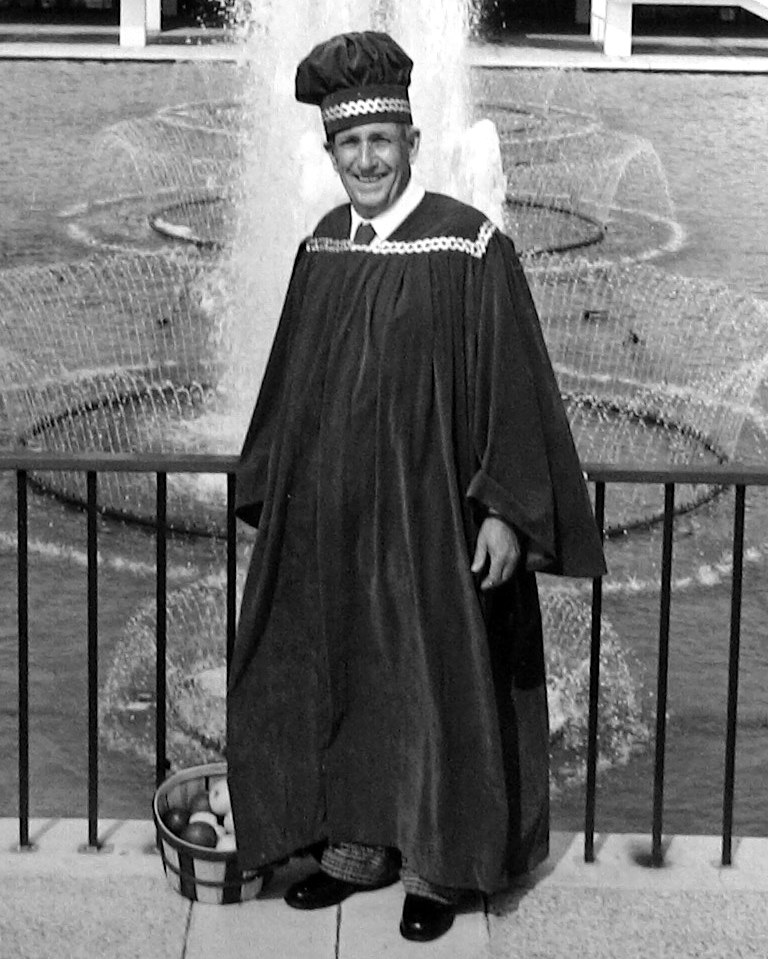
Uncle Cecil, the Apple King

This weekend is Apple Day in Paintsville, Kentucky. Officially, it’s the Kentucky Apple Festival, but everyone calls it Apple Day.
 
It’s basically a county fair. There’s a carnival and a parade and a lot of food, like apple pie, caramel apples and apple butter. There aren’t really a lot of orchards in Johnson County, but there are a few, and every year, the farmer with the best apples is proclaimed the Apple King.
 
When I was 8 years old, my Great Uncle Cecil was Apple King because of his Minerva apples.
 
Cecil was Granny’s brother. He and Aunt Minerva never had kids, but people adopted them as surrogate grandparents. They lived in a log house they built themselves on a small farm up a hollow near a place called Meally.
 
They bickered a lot. Minerva was a little hard of hearing, and Cecil sort of mumbled. He’d say something, she wouldn’t understand him, so he’d say it louder and louder until she understood or accused him of yelling at her, but they loved each other deeply.
 
Cecil was kind of a hacker in the DIY-sense of the word. He loved taking things apart and seeing how they worked and trying to make them do things they weren’t meant to do. He tinkered with old radios and model trains, and he tinkered with his apple trees.
 
I don’t know a lot about horticulture, but he would take stems from one kind of apple tree and graft them onto another one, and after many years, he came up with a hybrid he called the Minerva apple.

Minerva apples were yellow and big and perfect — crisp, not mushy, and a little more sweet than tart. When he finally entered the Minerva apple in the Apple Day contest, the other farmers didn’t have a chance.

I don’t remember the last time I had a Minerva apple. As he and Minerva got older, Cecil let his orchard go, and, one year, there simply weren’t any more.
 
Minerva passed away in 1995, and Cecil died in 1999. I went to see him a few months before he died. He was sitting at the kitchen table, drinking coffee and watching CNN on the little TV in the corner. We were making small talk, and I asked how he came up with the Minerva apple. 

He grinned but wouldn’t tell me, because, really, those apples were always just Minerva’s apples.