Blog

You can’t judge a bookstore by its sign

Words n’ Stuff is a great little bookstore.

It’s in a place called Van Lear, in the hills of eastern Kentucky, near where I grew up.

Words n’ Stuff isn’t big, and it isn’t fancy. It doesn’t have a Starbucks, but if you’d ask, I’ll bet they’d give you a cup of coffee.

Words n’ Stuff is for people who love books. It has everything from local history to world religions, literary fiction to romance novels, new hard covers to used paperbacks.

If you go there, you’ll buy something. You can’t help it. You will.

We went there when we were visiting my folks last weekend, and we left with a memoir of Amelia Earhart’s first solo flight across the Atlantic, an Edmund Morris biography of Theodore Roosevelt, a book of essays by Jonathan Franzen and some children’s books.

We might have bought more, but Thing 2 got restless. There’s a good children’s section at Words n’ Stuff, but no train tables.

What impresses me most about Words n’ Stuff, though, is that it’s in Van Lear. Van Lear isn’t the place where you’d expect to find a great little bookstore.

Van Lear was built by the Consolidation Coal Co. in 1909 and named for a company director, Van Lear Black.

(If the name of the place sounds familar, it’s probably because Loretta Lynn mentions the Van Lear mines in her song, “Coal Miner’s Daughter,” and in the title song of her album, Van Lear Rose, which won a Grammy in a few years ago. Dwight Yoakum mentions the mines in the song, “Miner’s Prayer,” which was on Guitars, Cadillacs, Etc., Etc.)

Van Lear is unincorporated. There isn’t a downtown. Words n’ Stuff is one of Van Lear’s only retail businesses. People who live in Van Lear tend to shop and work someplace else.

I can’t find 2010 Census data for Van Lear, but in 2000, about 2,100 people lived in the bookstore’s ZIP code. Only 10% of them had bachelor’s degrees (the national average was 24%), while the median household income was $26,600 (compared with the national average of $42,000).

If you were Barnes & Noble’s or Borders, who wouldn’t give Van Lear a second look.

I think that’s worked to Van Lear’s advantage.

What the jukebox taught me about writing

Bobby Braddock’s been inducted into the Country Music Hall of Fame. You don’t know the name, but I guarantee you know his songs:

“He Stopped Loving Her Today,” by George Jones. “D-I-V-O-R-C-E,” by Tammy Wynette. “People Are Crazy,” by Billy Currington.

Here in Nashville, Bobby Braddock is a songwriting god.

Reading about him, I was reminded of something that’s easy to forget:

Songwriting, like any kind of writing, requires some talent, but mostly it takes a lot of work.

Songwriting is Bobby Braddock’s job. He can’t afford to sit around until something inspires him to write. He just has to write.

Listen to this. It’s from an interview Bobby Braddock did a few years ago with a website called larrywayneclark.com:

“Well, the people that think that lightning’s going to strike and that you can’t discipline yourself to do inspired work, I think that’s not true at all. You can make yourself write stuff, and you keep doing it and keep doing it and eventually the good stuff will come….”

That’s a great attitude when it comes to writing anything.

Here’s another example:

Couple years ago, I went to hear Bob McDill at the Hall of Fame. He’s another Nashville songwriter, one of the best: “Amanda,” by Waylon Jennings. “Good Ol’ Boys Like Me,” by Don Williams. “Gone Country,” by Alan Jackson.

Before he retired, he aimed to write a song a week. He had an office, and he went there, and he worked.

He said the song “Amanda” came in about 30 minutes, but “that’s the last gift I got. Afterward, it was blood, sweat and tears.”

He wrote a song with Dan Seals called “Everything That Glitters.” Here’s how it starts:

Saw your picture on a poster, in a cafe out in Phoenix;
Guess you’re still the sweetheart of the rodeo.
As for me and little Casey,  we still make the circuit
In a one-horse trailer and a mobile home.
And she still asks about you all the time;
And I guess we never even cross your mind.

There’s a lot of story in those six lines. McDill said he and Seals worked on that song for “months and months and months” until they figured it out, got everything just right.

Blood, sweat and tears.

Writing, any kind of writing, is work. It’s great if you’re inspired, but usually you’re not, and the only thing you can do is write through it, and if you’re lucky, the good stuff will come.

Cool hand, Luke

I finally let Thing 2 (the 5-year-old) watch Star Wars. We watched the original trilogy over a period of about a week.

We watched the movies together. I explained the parts he didn’t understand and, when things got scary, I told him to cover his eyes or reminded him that it was only pretend, and I fibbed my way through what I thought might be the really disturbing parts (I said they were only burning Darth Vader’s costume on the pyre at the end of “Return of the Jedi”).

I thought he’d have questions about Luke Skywalker being Vader’s son and Princess Leia’s brother, but he took both revelations in stride. His only question came a couple days after we watched “The Empire Strikes Back,” on our way home from preschool.

“Dad,” he said, “where’s Luke’s hand?”

“Well, Darth Vader cut it off with his lightsaber,” I said, thinking maybe I’d made a mistake and that he wasn’t old enough to watch the movies, even though most of his friends had.

“But he gets it back, right?”

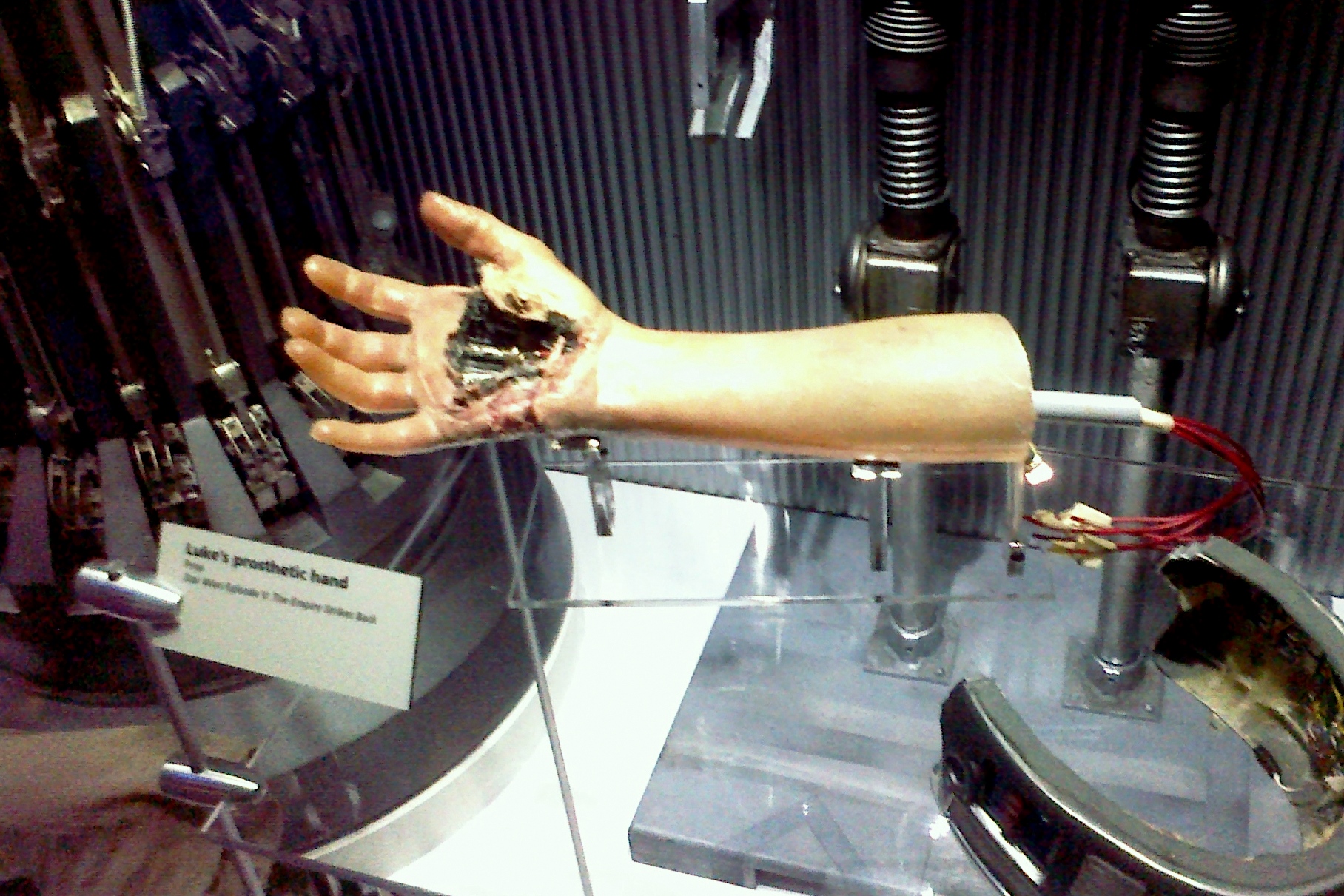
“Well, they give him a new hand, remember? On the spaceship, at the end of the movie? They give him a mechanical hand.”

“But where’s his real hand?”

“It, uh, fell.”

He was quiet then, but he asked me about Luke’s hand again the next day and the next, and I then realized he wasn’t thinking about Luke Skywalker as much as he was Mark Hamill, who played him. He wanted to know what happened to the actor’s hand in the scene where it looked like it got cut off.

“That was just pretend. He just pulled his sleeve down over his hand so you couldn’t see it, but it was still there, like this,” I said, pulling my sleeve down over my hand.

He understood and demonstrated to Sweetie when she got home from work.

I thought everything was OK until a few days after we’d watched “Return of the Jedi.”

“Dad, what happened to the snow monster’s arm?

“What do you mean?”

“When Luke cut it off. He didn’t have any sleeves. Where’d his arm go?”

PHOTO: Luke’s mechanical hand, from The Empire Strikes Back. Part of last summer’s Star Wars: Where Science Meets Imagination movie prop exhibit at the U.S. Space and Rocket Center, Huntsville, Ala.